
Listeria in the environment: a warning sign, yes – an automatic product recall, no
A positive environmental Listeria result is a serious warning sign. However, it does not automatically prove that the product is also contaminated, and therefore it does not always trigger an immediate recall. Key factors include the specific pathogen detected, the hygiene zone, proximity to the product, the type of food, shelf life, and any relevant product test results.
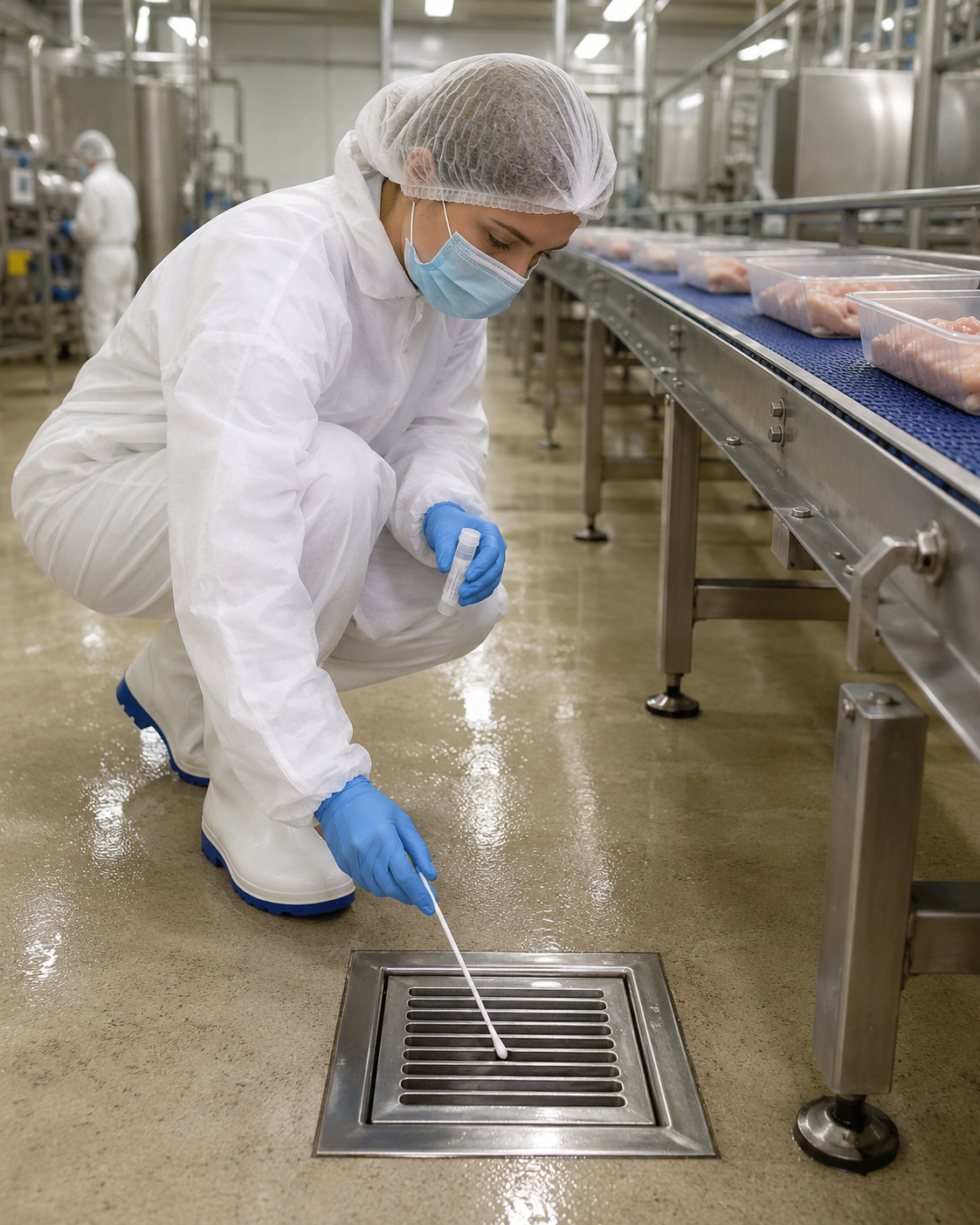
A positive Listeria result in the production environment is one of those findings that immediately sets off alarm bells in a facility. And rightly so. Listeria can take hold in damp production areas, colonize niches, and persist in the environment over long periods. This can create a significant product risk, especially for ready-to-eat foods.
However, it becomes problematic when an environmental finding leads to the immediate, unassessed conclusion:
Listeria found – therefore the product is contaminated and must be recalled.
It is not that simple. A positive environmental result is a serious warning sign, but it is initially just a finding at a specific sampling point. It does not automatically prove that a food product is contaminated or that unsafe product has already been placed on the market.
What does a positive environmental result actually tell us?
Its significance depends first and foremost on exactly what was detected.
Detection of Listeria spp. indicates that conditions may exist that allow Listeria to survive or spread within the facility. The finding can point to weaknesses in cleaning, drying, equipment design, zoning, or traffic patterns. It is therefore by no means harmless.
Listeria spp. are not, however, automatically equivalent to Listeria monocytogenes . Only the detection of this pathogenic agent significantly escalates the immediate food safety assessment.
The sampling location is also critical. A positive result in a floor drain outside the production area has a different meaning than detection:
- on a product-contact surface,
- immediately after cleaning,
- in a high-hygiene zone,
- after the final pathogen-reduction process step, or
- at a point where direct transfer to the product is possible.
Therefore, findings must always be evaluated in the context of the pathogen, sampling location, hygiene zone, and production process.
When does an environmental issue become a product risk?
Products that are not heated again after the final pathogen-eliminating process step are particularly critical. This includes many ready-to-eat foods.
The following questions, among others, are important for risk assessment:
- Is it a ready-to-eat product?
- Can Listeria monocytogenes multiply during its shelf life?
- How long is the shelf life?
- Is the site of the finding on or near a product contact surface?
- Was there a realistic transmission path during the affected production run?
- Are there other positive environmental findings?
- Was the same strain found repeatedly or in multiple locations?
- Are there any positive product findings?
- Which batches and production periods could be affected?
Only from this overall perspective can it be determined whether there is a relevant risk for a product that has already been shipped.
An environmental finding alone is therefore neither proof of a contaminated batch nor a reason to downplay the result. It is the starting point for a structured risk assessment.
Why negative product samples do not automatically solve the problem
In practice, a large number of finished product samples are often tested following a positive environmental finding. If these are negative, relief often follows quickly.
This conclusion must also be treated with caution.
Microbiological tests are based on random sampling. Contamination can be very low, unevenly distributed, or present in only a few individual packages. Negative results reduce the probability of contamination but do not prove that the entire batch is free of Listeria.
Conversely, a positive environmental finding does not mean that every package produced is affected.
Product testing is therefore only one component of the assessment. Knowledge of the process, spatial mapping, temporal delimitation, and the question of whether a plausible transmission path existed are at least as important.
Immediate actions to take in the facility
The first step is not a knee-jerk recall, but a controlled escalation.
The affected site should be secured and clearly assigned to a hygiene zone. Subsequently, it must be determined which products, lines, shifts, and production periods could theoretically be affected.
At the same time, cleaning and root cause analysis must be intensified. Simply using more disinfectant is not enough. You must look for the actual source:
- hard-to-reach equipment areas,
- cavities and dead spaces,
- damaged seals,
- condensation,
- drains,
- rollers and conveyor belts,
- cleaning equipment,
- splash water,
- personnel and material movements, or
- damp areas that do not dry sufficiently after cleaning.
Targeted follow-up sampling is then advisable. This should not be done randomly, but rather map potential spread paths: from the site of the finding toward the product contact area, as well as along water, personnel, and material routes.
Product samples can supplement this investigation. However, they do not replace a root cause analysis.
When product withdrawals or recalls may be necessary
If the overall data provides reasonable grounds to suspect that an unsafe food product has been placed on the market, the necessary measures must be assessed and initiated immediately.
This may be the case, for example, if:
- Listeria monocytogenes has been detected in the product,
- there is a positive result on a product contact surface after the final pathogen-reduction step,
- a plausible direct transmission route existed,
- multiple related findings point to a persistent source of contamination, or
- the product in question supports the growth of Listeria monocytogenes throughout its shelf life.
Depending on the situation, an internal hold, a withdrawal from the supply chain, or a public recall may be required. The decision must be risk-based, transparent, and documented.
However, it would be equally wrong to rule out a recall simply because no positive product sample has been found yet.
Conclusion
A Listeria finding in the production environment is a serious matter that requires professional attention, but it does not automatically necessitate a product recall.
A well-managed facility responds consistently: it secures the site of the finding, intensifies cleaning and monitoring, investigates potential transmission routes, isolates affected products, and assesses the risk based on all available information.
Anyone who reflexively triggers a product recall for every environmental finding is confusing risk assessment with panic management.
Conversely, anyone who treats it as a mere cosmetic issue is underestimating a potential early warning signal.
The right approach lies somewhere in between: structured, evidence-based, and risk-oriented.
Publications & Technical Papers
Practical experience — passed on in specialist literature, training courses and contributions on food safety.

Director Food Safety Senior Experts, Microbiologist & Food Safety Expert
With decades of experience in audits, quality management and crisis situations, she combines scientific principles with operational practice. Her publications make complex topics such as HACCP, food safety culture and risk analysis understandable and directly applicable. For companies that not only pass certifications, but also want to sustainably improve their systems.
.jpg)