
Cleaning under control
Cleaning and disinfection are often viewed as routine. They are anything but. They are a process that must be scientifically grounded, validated, and continuously monitored, as they determine the microbiological safety of an entire operation. In industrial production, this process is frequently outsourced to specialized cleaning service providers. While this makes sense, it does not absolve the company of its responsibility.
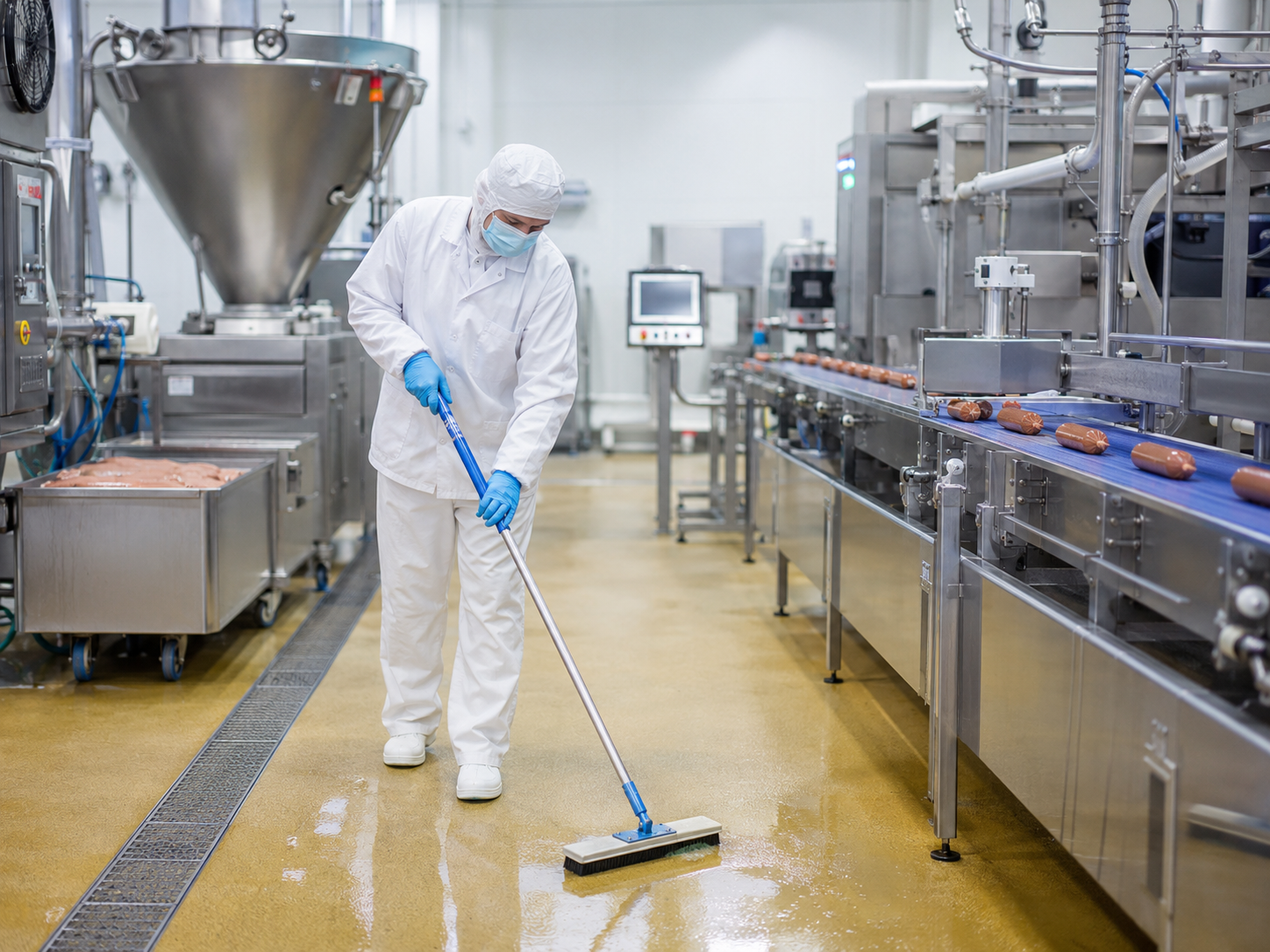
Why monitoring outsourced cleaning services is critical to microbiological safety
Cleaning and disinfection are often viewed as routine. They are anything but. They are a process that must be scientifically grounded, validated, and continuously monitored, as they determine the microbiological safety of an entire operation. In industrial production, this process is frequently outsourced to specialized cleaning service providers. While this makes sense, it does not absolve the company of its responsibility. This newsletter explains why.
The invisible risk: Biofilms
Microorganisms do not just sit loosely on surfaces; they organize. A biofilm is a microbial community attached to a surface, embedded in a self-produced matrix of extracellular polymeric substances (EPS) (Frontiers in Microbiology, 2018). This matrix acts as a protective shield. Cells within a biofilm are significantly more resistant to disinfectants than free-floating, so-called planktonic cells (Bridier et al., 2011).
Biofilms thrive where cleaning is difficult: in floor drains, on conveyor belts, in seals, and on cutting surfaces (Microorganisms, 2025). Multi-species biofilms consisting of various germs are more resilient than those formed by a single species.
Sporadic or incomplete cleaning can preserve biofilm niches and spread cells. Spraying and high-pressure cleaning near contaminated drains are particularly critical. In one model study, a two-second water spray into a contaminated floor drain was enough to transfer Listeria through the air onto raw poultry located 2.4 meters away on a work surface (Berrang et al., 2013).
The case study: Listeria monocytogenes
A single pathogen makes the problem tangible. Listeria monocytogenes is ubiquitous in the environment and can become permanently established in production facilities. Ready-to-eat foods—products that undergo no further germ-killing step before consumption—are particularly at risk (Gupta and Adhikari, 2022).
Persistent strains in production facilities are considered the most common cause of post-processing contamination in ready-to-eat products and have been linked to several listeriosis outbreaks (Journal of Food Protection, 2015). The pathogen forms biofilms on stainless steel, plastic, and rubber, and it can multiply at refrigeration temperatures. L. monocytogenes is not heat-resistant in the sense of pasteurization. However, its persistence in biofilms and environmental niches, combined with its tolerance to certain treatments up to approximately 60 degrees Celsius, makes complete eradication difficult (Frontiers in Microbiology, 2018).
For industrial production, this means the critical point is not just in the product; it is in the facility and its cleaning processes.
Disinfection is about measurable results, not good intentions
Whether disinfection works depends on the active ingredient, concentration, contact time, and the type of pathogen. A systematic review and meta-analysis determined that chemical disinfectants achieve an average germ reduction of approximately 2.90 log cycles against biofilms on food-contact surfaces, ranging from about 2.67 to 3.82 depending on the agent. Substances studied included peracetic acid, quaternary ammonium compounds, and sodium hypochlorite. Significant influencing factors were the type of active ingredient and the pathogen species. The type of surface showed no significant influence in this meta-analysis (Hamilton et al., 2025).
In practice, this is no reason to let your guard down. Cleaning and disinfection procedures must be validated for the specific surfaces, equipment, and conditions of your own facility. Effectiveness must be proven, not just the act of cleaning itself.
How do you verify cleanliness?
ATP bioluminescence is the most common rapid testing method. It measures adenosine triphosphate (ATP), a molecule found in all living cells, as a marker for organic residues. Results are available in relative light units (RLU) within minutes. While the method is valuable for quick verification, its limitations must be clearly understood.
• ATP is not a test for pathogens. It measures organic residues, not microbial counts. RLU values do not correlate directly with colony-forming units.
• Viruses do not produce an ATP signal. Bacterial spores and low microbial loads are detected inadequately or unreliably.
• Cleaning and disinfection chemicals, as well as the surface itself, can influence the measurement (Lane et al., 2020).
There are no universally standardized RLU limit values. These must be established on a site- and zone-specific basis following a validation phase. ATP therefore complements microbiological sampling; it does not replace it.
Pathogen control requires more. An environmental monitoring programme (EMP) systematically checks whether hygiene measures are effective. It is based on a risk-based hygienic zoning concept that divides the facility into areas of varying risk, typically Zone 1 to Zone 4 (Gupta and Adhikari, 2022). The goal is to actively detect and eliminate persistent niches. This approach is known as "seek and destroy" (Journal of Food Protection, 2015).
Outsourced does not mean off the hook
This brings us full circle. Outsourcing cleaning to external service providers is common in the industry and often makes sense. It shifts the task, but it does not shift the legal responsibility.
Article 17 of Regulation (EC) No 178/2002 requires food business operators to ensure that the relevant requirements of food law are met within their businesses and to verify that these requirements are fulfilled. Regulation (EC) No 852/2004 requires that facilities be kept clean and maintained, and that equipment coming into contact with food be effectively cleaned and, where necessary, disinfected (Annex II).
IFS Food Version 8 requires risk-based plans for cleaning and disinfection that must be validated, documented, and implemented (Requirement 4.10.1). The effectiveness of cleaning and disinfection measures must be verified based on a risk-based sampling plan, for example through visual inspection, rapid tests, and analytical examination methods (4.10.7). If a company commissions a service provider to perform cleaning and disinfection activities in production areas, all the aforementioned requirements must be documented in the corresponding service contract (4.10.9). Furthermore, personal hygiene requirements must be understood and applied by employees, service providers, and external personnel. This is a knockout criterion (3.2.2).
In short: The service provider does the cleaning. The company remains responsible for monitoring and proving the effectiveness of that cleaning.
What a robust monitoring concept requires
Six building blocks emerge from the legal and scientific foundations. They apply regardless of whether cleaning is performed internally or externally:
• Clear responsibilities and service contracts. Who cleans what, when, with what, at what concentration, and with what contact time. When production areas are cleaned by external parties, these requirements must be documented in the contract.
• Validated procedures. Proof that cleaning and disinfection are effective on the specific surfaces and equipment, not just that they were performed.
• Risk-based verification with threshold values. Visual inspection, ATP measurement with zone-specific validated RLU thresholds, and supplementary microbiological sampling based on a risk-based sampling plan.
• Environmental monitoring based on a zoning concept. In high-risk areas, using targeted seek-and-destroy sampling for Listeria.
• Qualification and training of service provider personnel. Accountable, because personal hygiene and expertise requirements apply to external staff as well.
• Documentation, trend analysis, and corrective actions. Deviations are recorded, analyzed, and demonstrably resolved (CAPA, corrective and preventive actions).
Conclusion
Cleaning is not a cost center. Cleaning is process reliability. Outsourcing the work does not mean outsourcing the responsibility. The good news: cleanliness is measurable. You just need to combine the right methods and validate the thresholds specifically for your operation.
Would you like to put your cleaning and monitoring concept or the management of your cleaning service providers to the test? We support you with audit-proven expertise in microbiology, HACCP, and quality management.
CPM Food Safety Senior Experts, Karlsruhe. www.foodsafetyseniorexperts.de
Literature and legal foundations
1. Regulation (EC) No 178/2002 laying down the general principles and requirements of food law, in particular Article 17.
2. Regulation (EC) No 852/2004 on the hygiene of foodstuffs, in particular Annex II.
3. International Featured Standards: IFS Food Version 8 (2023), requirements 3.2.2 as well as 4.10.1, 4.10.7 and 4.10.9.
4. Bridier A, Briandet R, Thomas V, Dubois-Brissonnet F; 2011; Resistance of bacterial biofilms to disinfectants: a review. Biofouling 27(9): 1017-1032.doi:10.1080/08927014.2011.626899.
5. Galie S, Garcia-Gutierrez C, Miguélez EM, Villar CJ, Lombó F; 2018; Biofilms in the Food Industry: Health Aspects and Control Methods. Frontiers in Microbiology 9:898. doi:10.3389/fmicb.2018.00898.
6. Berrang ME, Frank JF, Meinersmann RJ; 2013; Contamination of raw poultry meat by airborne Listeria originating from a floor drain. Journal of Applied Poultry Research 22(1), 132–136. doi:10.3382/japr.2012-00676.
7. Gupta P, Adhikari A; 2022; Novel Approaches to Environmental Monitoring and Control of Listeria monocytogenes in Food Production Facilities. Foods 11(12):1760.doi:10.3390/foods11121760.
8. Seek and Destroy Process: Listeria monocytogenes Process Controls in the Ready-to-Eat Meat and Poultry Industry. Journal of Food Protection (2015).doi:10.4315/0362-028X.JFP-13-507.
9. Hamilton AN, Jones SL, Baker CA, Liang X, Siepielski A, Robinson A, Dhulappanavar GR,Gibson KE; 2025; A Systematic Review and Meta-Analysis of Chemical Sanitizer Efficacy Against Biofilms of Listeria monocytogenes, Salmonella enterica, and STEC on Food Processing Surfaces. Journal of Food Protection, Article 100495.doi:10.1016/j.jfp.2025.100495.
10. Lane K, McLandsborough LA, Autio WR, Kinchla AJ; 2020; Efficacy of ATP monitoringfor measuring organic matter on post harvest food contact surfaces. Journal of Food Protection 83(10), 1829–1837. doi:10.4315/0362-028X.JFP-19-443.
11. Ban-Cuceran A, Imre K, Morar A, Marcu A, Hotea I, Popa S-A, Patrinjan R-T, Bucur I-M,Gaspar C, Plotuna A-M, Ban S-C; 2025; Persistent Threats: A Comprehensive Review of Biofilm Formation, Control, and Economic Implications in Food Processing Environments. Microorganisms 13(8):1805.doi:10.3390/microorganisms13081805.
Publications & Technical Papers
Practical experience — passed on in specialist literature, training courses and contributions on food safety.

Director Food Safety Senior Experts, Microbiologist & Food Safety Expert
With decades of experience in audits, quality management and crisis situations, she combines scientific principles with operational practice. Her publications make complex topics such as HACCP, food safety culture and risk analysis understandable and directly applicable. For companies that not only pass certifications, but also want to sustainably improve their systems.
.jpg)