
Food Defense 2026: Is your concept still sufficient?
In 2026, food defense is about more than just fences, access control, and visitor logs. Recent tampering cases, the new PAS 96:2026, and the German KRITIS Umbrella Act highlight how much the threat landscape has shifted. It is time for a critical look at your own threat analysis: where is your facility truly vulnerable today?
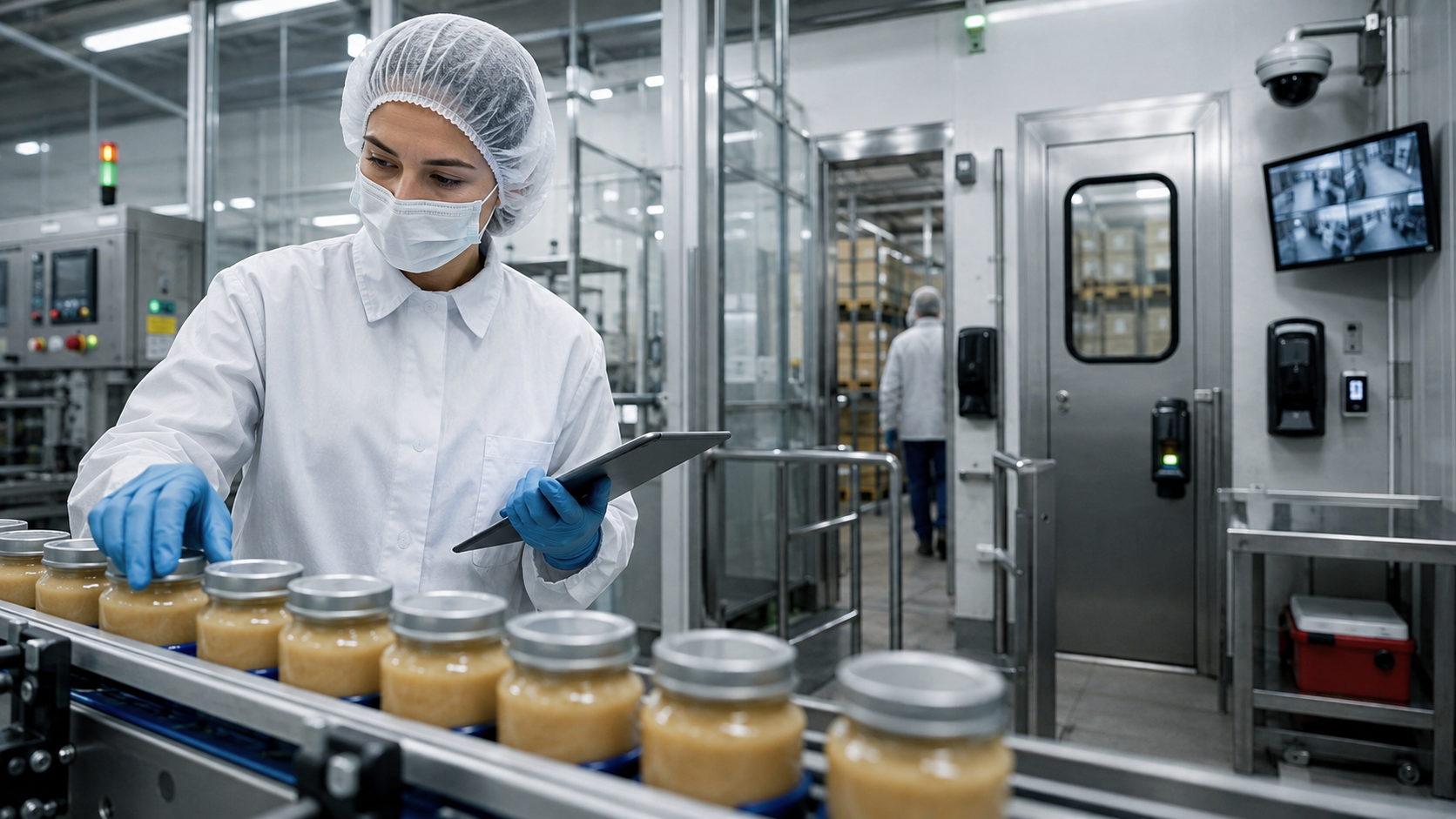
For a long time, food defense in many companies consisted of nothing more than a fence, a visitor log, locked doors, and an annual threat analysis that was signed off as a formality.
2026 makes it quite clear: that is no longer enough.
In the spring, five jars of Hipp baby food tampered with rat poison were discovered in Austria, the Czech Republic, and Slovakia. The company was blackmailed for millions. A suspect later arrested was a former Hipp employee. He denies the allegations. It has not yet been conclusively determined where or by whom the products were actually tampered with.
Nevertheless, the case highlights a major weakness in traditional food defense concepts: The threat does not end at the factory gate.
This is exactly what the fundamentally revised PAS 96:2026addresses. The guide no longer looks only at linear supply chains, but at complex supply networks. Cybercrime is given significantly more weight. TACCP is more systematically embedded into the PDCA cycle, measures are expected to be proportionate to the threat, and confidential reporting systems are explicitly addressed.
There is also movement on the regulatory front: since March 17, 2026, the KRITIS Umbrella Acthas been in effect in Germany. The food sector is explicitly included. However, by no means every food company is affected. The decisive factors are the specific categories and thresholds for critical infrastructure; the law cites 500,000 people supplied as the general benchmark.
Questions you should ask yourself:
1. Who could actually gain access to our product?
Not just production staff, but also external contractors, logistics personnel, former employees, or individuals within the wider supply network.
2. Which access rights remain active after an employee leaves?
Keys and access cards are only part of it. Recipes, label printing, production control, and traceability are also critical.
3. Have we evaluated cyberattacks as a food defense issue?
Today, an attacker does not need to open a door to manipulate production or product information.
4. Can employees report suspicious activity confidentially?
5. Do we know what to do if someone claims tomorrow that they have poisoned products in stores?
Who makes the decisions? Who notifies the police and authorities? How quickly can we isolate supply chains?
Conclusion
Food defense hasn't suddenly become a new concept in 2026. But the threat landscape has changed.
Anyone who has been updating their analysis for years using the same scenarios, the same assessments, and the same measures should not simply enter the next review date.
Instead, ask yourself once more:
Where are we truly vulnerable today?
Publications & Technical Papers
Practical experience — passed on in specialist literature, training courses and contributions on food safety.

Director Food Safety Senior Experts, Microbiologist & Food Safety Expert
With decades of experience in audits, quality management and crisis situations, she combines scientific principles with operational practice. Her publications make complex topics such as HACCP, food safety culture and risk analysis understandable and directly applicable. For companies that not only pass certifications, but also want to sustainably improve their systems.
.jpg)