
Food Safety Culture: A Recurring Theme
The crucial question about food safety culture isn't: Is there a system? Instead, it's: Does it work under time pressure, in daily operations, and without direct supervision? Are deviations reported promptly? Is a risk taken seriously? Are safe decisions still made even under pressure? This is precisely where Food Safety Culture truly begins.
HACCP without culture fails!
Many food companies today are technically and regulatorily well-positioned, yet we still see recalls, recurring hygiene failures, and processes that appear safe on paper but remain unstable in practice. Food safety repeatedly fails due to behavior, communication, prioritization, and leadership, not due to the often well-developed documents. This is precisely what current research once again demonstrates (Podlesnik & Raspor; 2026; Modern Food Systems challenged by Food safety Culture; Food technol Biotechnol 64 (1): 81-96). Even strong management systems lose their effectiveness if safe routines are not consistently lived out.
The crucial question is not: Is there a system?, but: Does it work even under time pressure, in everyday situations, and without direct supervision? Is a deviation reported early? Is a risk taken seriously? Are safe decisions still made under pressure? This is precisely where Food Safety Culture begins.
Many companies primarily measure technical or formal key performance indicatorsHACCP without culture fails!
Many food companies today are technically and regulatorily well-positioned – yet we still see recalls, recurring hygiene failures, and processes that appear safe on paper but remain unstable in practice. Food safety repeatedly fails due to behavior, communication, prioritization, and leadership – and not due to the often well-developed documents.
This is precisely what current research once again demonstrates: Podlesnik & Raspor (2026) prove in Modern Food Systems challenged by Food Safety Culture (Food Technol Biotechnol 64 (1): 81–96), that even strong management systems lose their effectiveness if safe routines are not consistently lived out.
The crucial question
Not: Is there a system? – but: Does it work even under time pressure, in everyday situations, and without direct supervision?
- Is a deviation reported early?
- Is a risk taken seriously?
- Are safe decisions still made under pressure?
This is exactly where Food Safety Culture begins.
From Lagging to Leading Indicators
Many companies primarily measure technical or formal metrics: complaints, audit deviations, temperature trends, or training rates. These figures are important – but they are lagging indicators. They only show that something has already gone wrong.
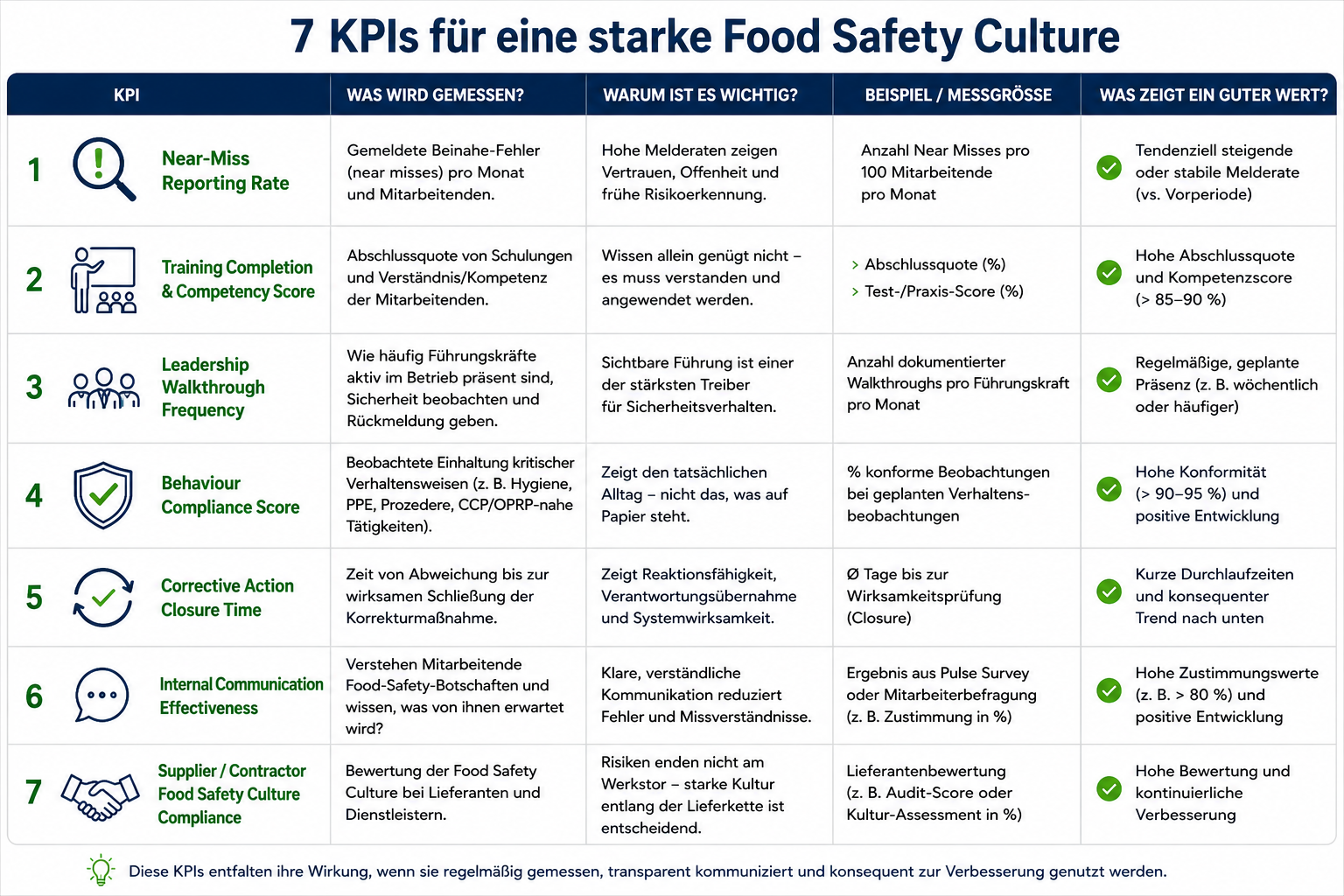
A strong Food Safety Culture becomes visible earlier: Transparency, responsiveness, leadership behavior, learning ability, and how small errors are handled are key indicators that reflect daily decisions. Podlesnik & Raspor present concrete KPIs that measure the implementation of such a culture.
Particularly interesting is the aspect "Near misses": As with Heinrich's Accident Pyramid, many small errors can indicate that a major error is highly likely to follow – simply statistics. That's why it's so important to take the small "oops..." seriously. If it occurs repeatedly, action must be taken.
→ To the article by Podlesnik & Raspor (Open Access)
Leadership is Required – Not Just Documentation
The new book Food Safety Culture by Andrea Dreusch and Matthias Lehrke (Lehrke Verlag, 2026) suggests a similar idea: A company doesn't primarily fail due to a lack of procedures, but because behavior, values, and daily decisions are not consistent with food safety. Technology, training, and management systems are established – but that alone is no longer enough.
We are entering a new phase that explicitly demands leadership: in measurement and evaluation, in leading by example, and in active participation.
→ To the book at Lehrke Verlag
What the Standard Setters Say
The GFSI released Version 2.0 of its guidance in March 2026 A Culture of Food Safety published. The conclusion: Food Safety Culture is not a "soft topic" but a measurable factor for food safety performance – and must be considered in conjunction with FSMS/HACCP.
→ GFSI Position Paper (March 2026)
The SQFI complements with its new Food Safety Culture Assessment Plan Guidance (March 2026): Assessment must capture behavior, attitudes, and decisions – not just documents. KPIs, interviews, and observations are explicitly mentioned.
→ SQFI Guidance Document (March 2026)
Spirituality as a cultural factor?
Another research article takes an unusual direction: Chen (2026) combines in Fostering food safety culture in food service organizations (Front. Public Health 14:1717466) findings from organizational psychology, behavioral economics, and public health.
The thesis: Workplace Spirituality – understood as personal meaningfulness, ethical stance, connection to the team, and shared values – could contribute as a factor to rebuilding trust and fostering a more resilient food safety culture. Chen concludes: Food Safety Culture requires leadership, employee engagement, and practical implementation – not just knowledge transfer.
Making KPIs visible – for everyone
The Food Safety Magazine summarizes in March 2026 under the title What Food Safety KPIs say about Food Safety Culture:
- Companies that publish KPIs in the local language and with simple graphics foster a shared sense of responsibility on the front lines.
- Regular (monthly or quarterly) reviews keep safety on the agenda.
- A mix of outcome-oriented and preventive metrics indicates a mature, risk-based culture.
→ To the article in Food Safety Magazine
Culture Measurement Questionnaires: Potential and Limitations
Wang et al. (2026) provide, with Measuring Food Safety Culture: A Systematic Review of Questionnaire Dimensions and Validation Practices an overview of existing FSC questionnaires. Their finding: Questionnaires are widely used, but their diversity and inconsistency limit standardization and comparability between studies. Therefore, a consolidation of the various dimensions may be useful.
Conclusion: Much remains to be done
Food safety culture continues to evolve – but there's still a long way to go. The World Food Safety Day on June 7, 2026 can be a good opportunity to revisit the topic.
alen. Complaints, audit deviations, temperature trends, or training rates are important, but they are lagging indicators. These figures only show that something is already going wrong. A strong Food Safety Culture becomes visible earlier. Transparency, speed of reaction, leadership behavior, learning ability, and how small errors are handled are key indicators that reflect daily decisions. In their article, Podlesnik & Raspor highlight some metrics (see image) that illustrate a culture in its implementation. The aspect of "near misses" is particularly interesting here! Similar to Heinrich's accident pyramid, many small errors in food safety can indicate that a major error is highly likely to occur. Pure statistics! That's why it's so important to take the small "oops..." seriously. If it occurs repeatedly, something must be done about it. https://ftb.com.hr/images/pdfarticles/2026/January-March/FTB-64-81.pdf
Also in the new book "Food Safety Culture" by Andrea Dreusch and Matthias Lehrke (https://www.lehrke-verlag.de/product-page/lebensmittelsicherheitskultur) this is discussed. However, the focus also shifts to another direction, which is currently evident in many companies: A company fails not primarily due to a lack of procedures, but because behavior, values, and daily decisions do not consistently align with food safety. Technology, training, and management systems are established, requirements exist on paper, and everyone has done good work, but that alone is not sufficient. With food safety culture, we are entering a new phase that explicitly calls for leadership in measurement and evaluation, in setting an example, and in active participation.
In March 2026, GFSI released Version 2.0 of its "A Culture of Food Safety" guideline, clarifying that Food Safety Culture is not a "soft topic" but a measurable factor for food safety performance; culture must be considered in conjunction with FSMS/HACCP. https://mygfsi.com/wp-content/uploads/2026/03/GFSI-Food-Safety-Culture-Position-Paper-March-2026.pdf
SQFI also released its "Food Safety Culture Assessment Plan Guidance" in March. It further states that assessment must capture behavior, attitudes, and decisions, not just documents. KPIs, interviews, and observations are explicitly mentioned. https://www.sqfi.com/docs/sqfilibraries/code-documents/guidance-documents/2026-updates/food-safety-culture-assessment-plan-guidance-document_032026_2.pdf?sfvrsn=dd9b0043_9
Another article (Chen; 2026; Fostering food safety culture in food service organizations; Front. Public Health 14:1717466) brings together insights from organizational psychology, behavioral economics, and public health, positing that spirituality, if thoughtfully operationalized, could contribute as a factor to rebuilding trust, strengthening procedural integrity, and fostering a more resilient and purpose-driven food safety culture. Here, "spirituality" refers to: (1) personal inner orientation: meaningfulness, ethical stance, sense of responsibility, self-reflection, value awareness, and (2) workplace spirituality: sense of purpose, connection with team/organization, value alignment, belonging, work as an opportunity to create added value, and (3) organizational cultural integrity: ethical leadership, culture of trust, care, shared values, responsibility orientation. Chen concludes that Food Safety Culture requires leadership, employee engagement, and practical implementation, not just knowledge transfer. file:///C:/Users/andre/Downloads/fpubh-14-1717466.pdf
In March 2026, Food Safety Magazine published "What Food Safety KPIs say about Food Safety Culture" and summarized: The breadth and depth of KPIs collected reflect how deeply food safety principles are embedded in daily operations. Companies that publish KPIs in the local language and use simple graphics foster a shared sense of responsibility among frontline employees. Regular (monthly or quarterly) reviews keep safety on the agenda and strengthen accountability. Furthermore, a mix of outcome-oriented and preventive metrics indicates a mature, risk-based culture. https://www.food-safety.com/articles/11208-what-food-safety-kpis-say-about-food-safety-culturepart-2
Food safety culture continues to evolve, but there is still much to be done. World Food Safety Day on June 7, 2026, can be an opportunity to revisit the topic!
Also of interest might be the work by Wang et al; 2026; In their article "Measuring Food Safety Culture: A Systematic Review of Questionnaire Dimensions and Validation Practices," the authors provide an overview of FSC questionnaires and highlight their limitations. "The results show that while questionnaires are a widely used instrument, their diversity and inconsistency in terms of scope, theoretical basis, and validation rigor likely limit standardization and comparability across studies". Therefore, a consolidation of the various aspects may be useful. file:///C:/Users/andre/Downloads/Comp%20Rev%20Food%20Sci%20Food%20Safe%20-%202026%20-%20Wang%20-%20Measuring%20Food%20Safety%20Culture%20A%20Systematic%20Review%20of%20Questionnaire%20Dimensions.pdf
Publications & Technical Papers
Practical experience — passed on in specialist literature, training courses and contributions on food safety.

Director Food Safety Senior Experts, Microbiologist & Food Safety Expert
With decades of experience in audits, quality management and crisis situations, she combines scientific principles with operational practice. Her publications make complex topics such as HACCP, food safety culture and risk analysis understandable and directly applicable. For companies that not only pass certifications, but also want to sustainably improve their systems.
.jpg)